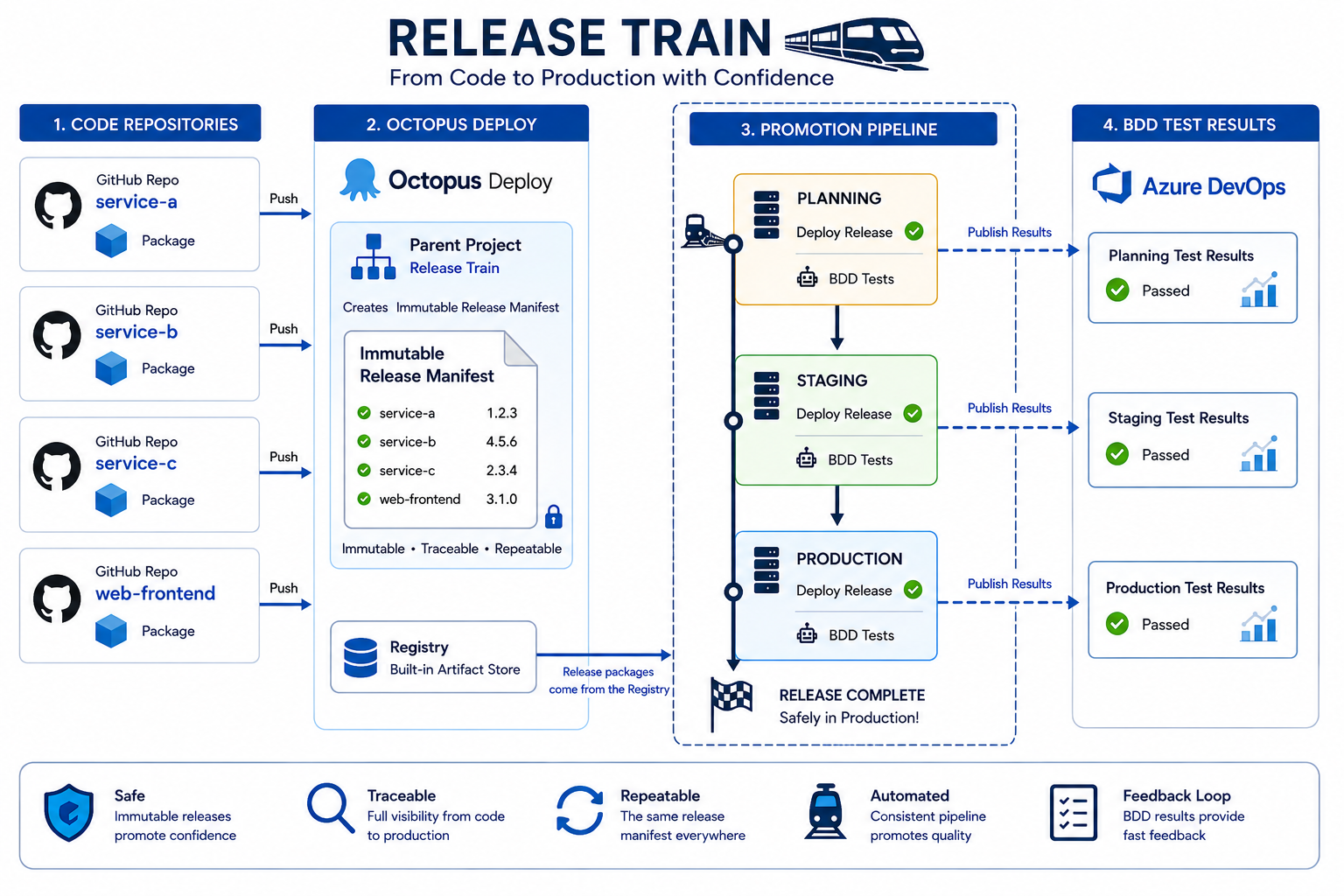
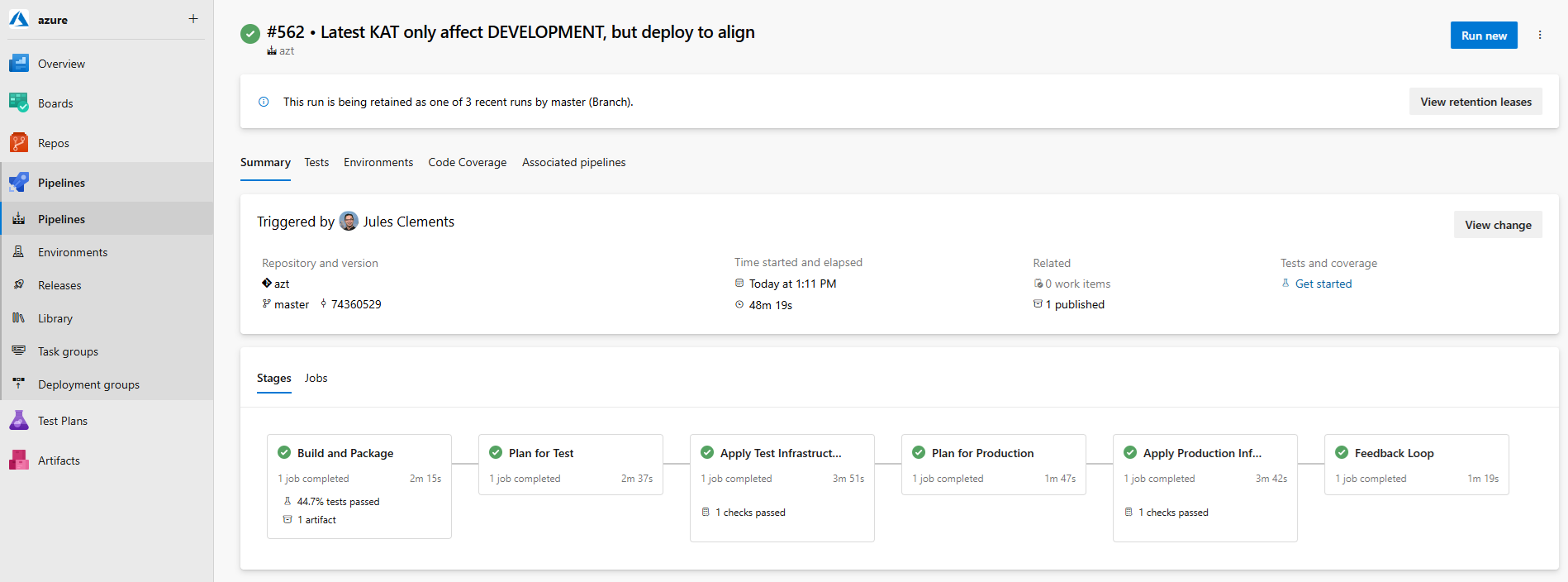
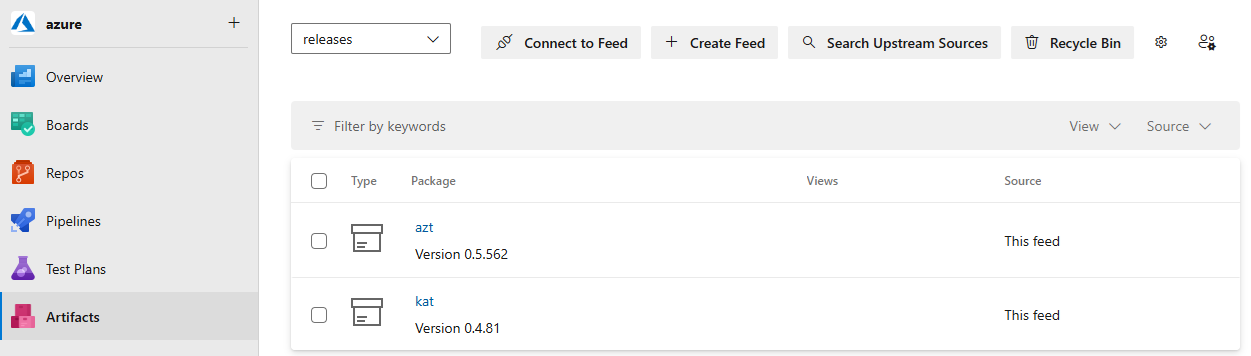
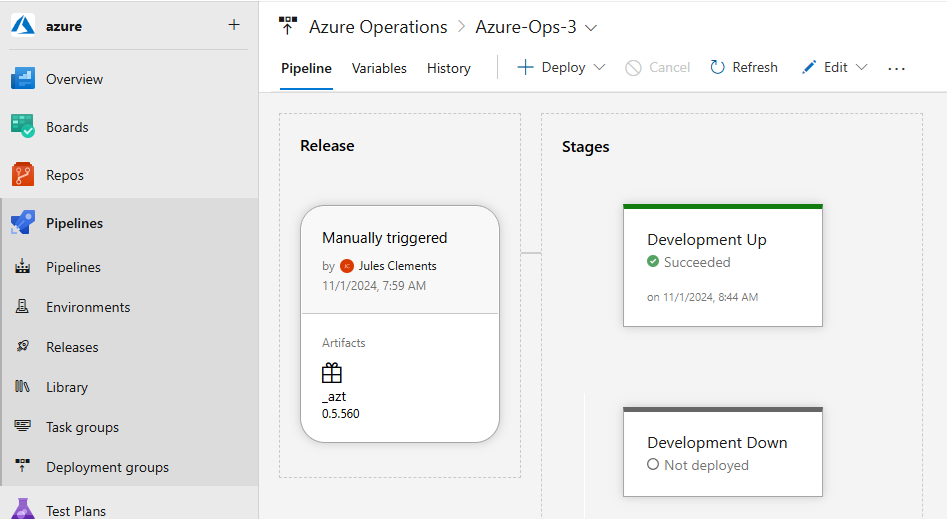
In a large scale environment, a release can include infrastructure, operational and application changes. In Scaled Agile Framework (SAFe) language, the role of coordinating these changes is called the Release Train Engineer (RTE). In many organisations, the coordination of these changes is manual. Automation of this coordination extends the Autonomous Development, Authoritative Release approach to include all aspects of the solution.
Release Train Engineering objectives preserve Autonomous Development, while ensuring the development output assets extend beyond application development, and may include infrastructure, configuration management and test automation.
Fundamental to Release Train Engineering is a Desired State Engine. Examples of these include Terraform, Amazon Cloud Development Kit, Azure Resource Manager/Bicep, Helmsman, Helmfile, Puppet, Ansible, Octopus*.
Intermediary
An intermediary provides a decoupled solution to perform the deployment actions of the release, based on a triggering request from the pipeline. Intermediaries, also known as orchestrators, can provide state management persistence, state reporting and drift remediation.
Octopus does not have a Desired State capability as such, but using a parent project, a release manifest can be constructed, and only child projects which have changed will be deployed. See detailed explanation in Octopus Deploy section.
Subsections of Release Train
Azure DevOps (ADO) Release
Orchestrated Component Deploy
The Application Stack in this example deploys two components, static content and an API.
graph TD

  Agent["🌐"]

  subgraph vm1["☁️ CloudFlare"]
    content["Static Content"]
    API
  end

  Agent --> content
  Agent --> API

classDef external fill:lightblue
class Agent external

classDef dashed stroke-dasharray: 5, 5
class vm1,vm2,vm3,vm4 dashed

classDef dotted stroke-dasharray: 2, 2
class vm1-pod-1,vm1-pod-2,vm2-pod-1,vm2-pod-2,vm3-pod-1,vm3-pod-2,vm4-pod-1,vm4-pod-2 dotted
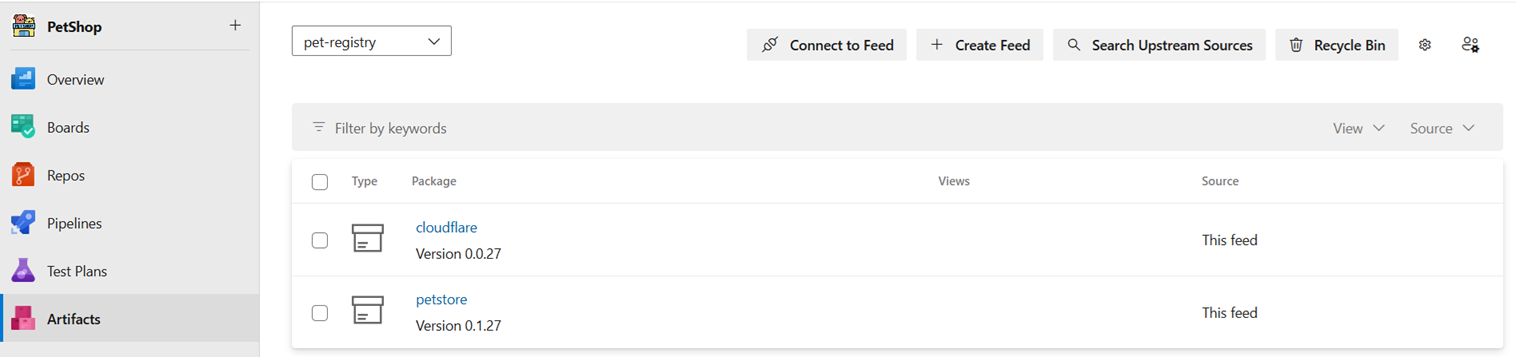
Each component publishes a self-contained release package to the Azure DevOps (ADO) artefact store. The ADO Release orchestrates these package deployments for each environment, ensuring the complete stack is promoted through each environment with aligned package versions.
graph LR

  subgraph static["Static Content"]
    Sbuild["Build"] -->
    Stest["Test"] -->
    Spublish["Publish"]
  end
  subgraph API
    Abuild["Build"] -->
    Atest["Test"] -->
    Apublish["Publish"]
  end

  subgraph Release
    TEST
    PROD
  end

  store[(ADO Store)]

  Apublish --> store
  Spublish --> store
  store --> TEST
  TEST --> PROD

classDef release fill:lightgreen
class TEST,PROD release
Each component contains both application code and deployment automation. The development team can imperatively deploy to the dev environment, i.e. the API and Vue application can be deployed separately, with no assurance of version alignment.
Example Vue properties.cm file, the deployment tool used is Wrangler.
context    target  pages_app_project  fqdn                 api_url
container  DEV     petstore-dev       vue-dev.example.com  api-dev.example.com

container  TEST    petstore-tst       vue-tst.example.com  api-tst.example.com
container  PROD    petstore-prd       vue.example.com      api.example.com
Example API properties.cm file, the deployment tool used is Terraform.
context    target tf_work_space  pages_suffix
container  DEV    PetStack-Dev   dev
container  TEST   PetStack-Test  tst
container  PROD   PetStack-Prod  prd
Due to the loose-coupling principle of CDAF, the same pipeline template is used for both components, even though the code and deployment automation are different (see orchestration templates in GitHub for Windows and Linux).
note that Jest for Vue and Checkov for Terraform have both been configured to output results in JUnit XML format.
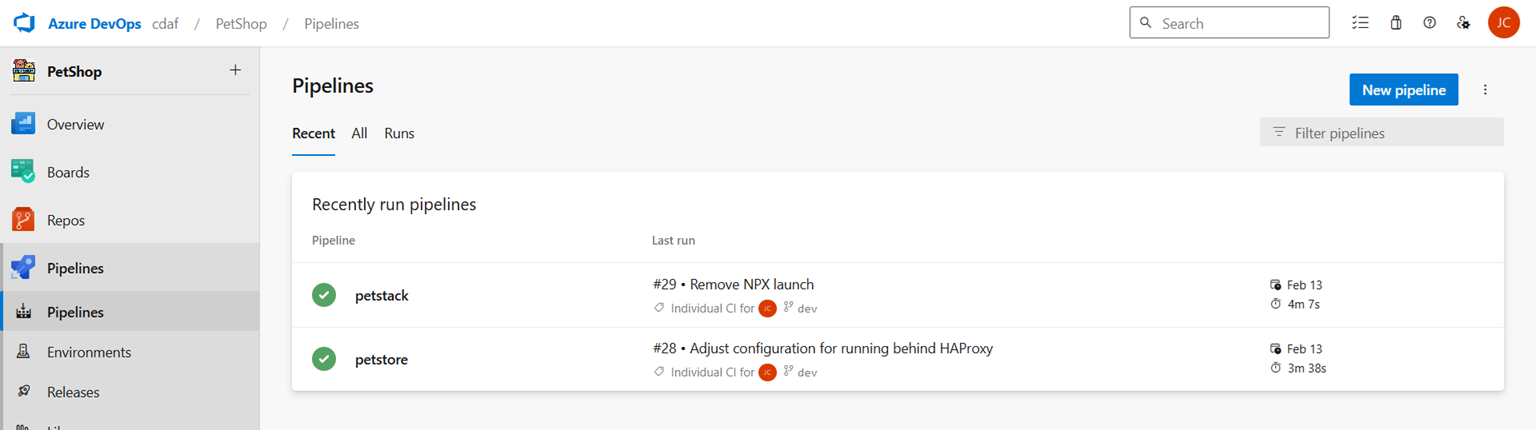
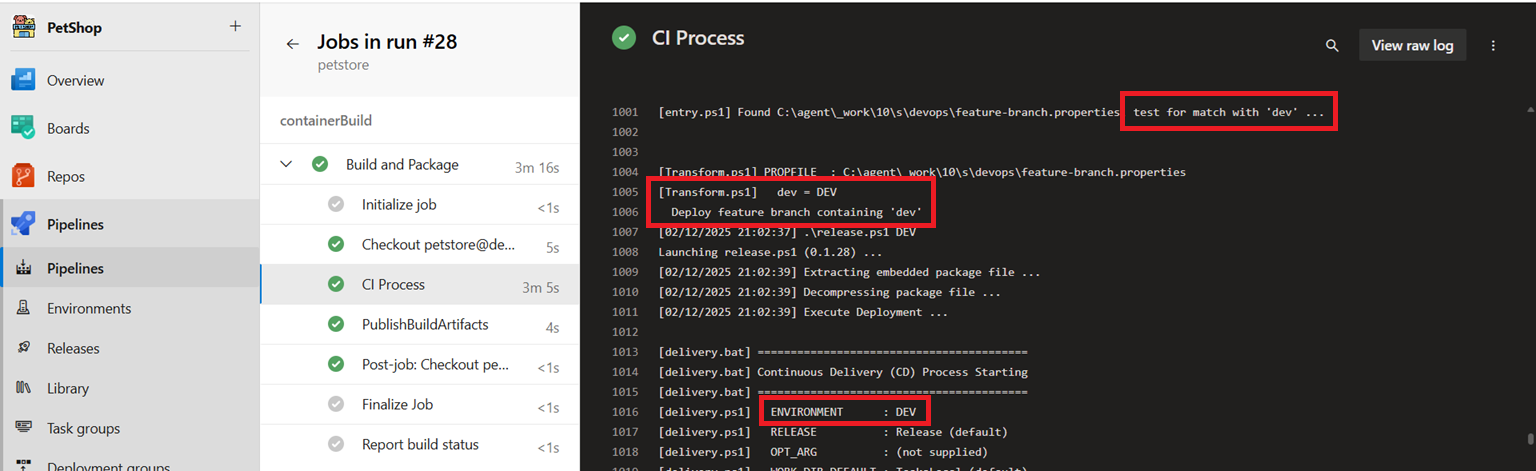
By using the feature-branch.properties capability of CDAF, branches containing the string dev will deploy to the development environment. This feature allows imperative deployment by the development team, without manipulating the pipeline, and therefore avoiding drift.
vue
# Feature Branch name match mapping to environment
dev=DEV
API
# Feature Branch name "contains" mapping to environment
dev=DEV release 'apply --auto-approve'
In the feature branch, where dev is in the branch name, CDAF will detect and execute a deployment, using the mapping above to invoke a release to DEV.
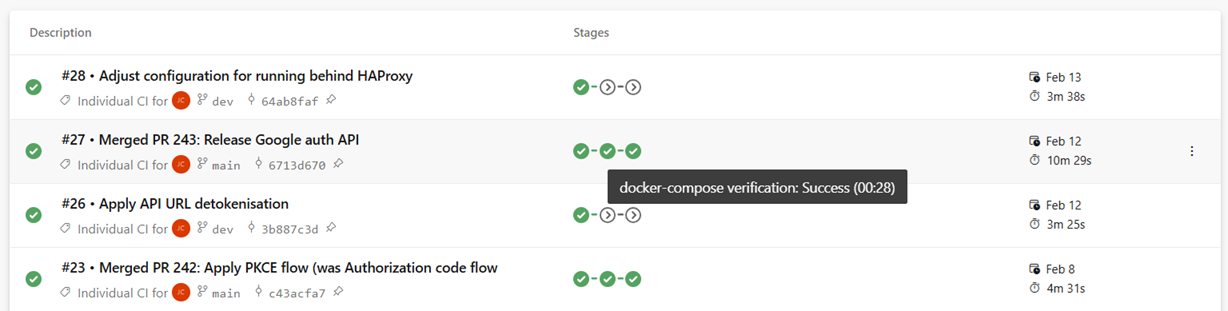
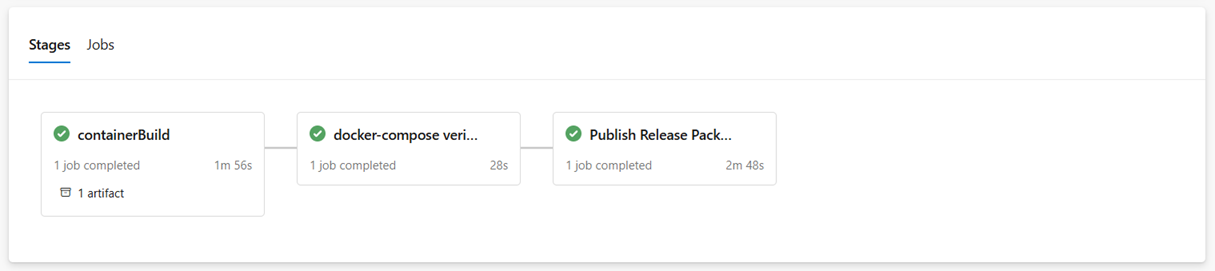
The trunk based pipeline will only push a release artefact from the main branch, with a stand-up/tear-down integration test of the production build.
the final stage of the main pipeline is publication. This pushes the release package to the artefact registry.
Each component publishes their release package, so although they use different technologies, they are now available as consistent packages, using the CDAF package process, which outputs a self-extract release.ps1 (of release.sh for linux) file.
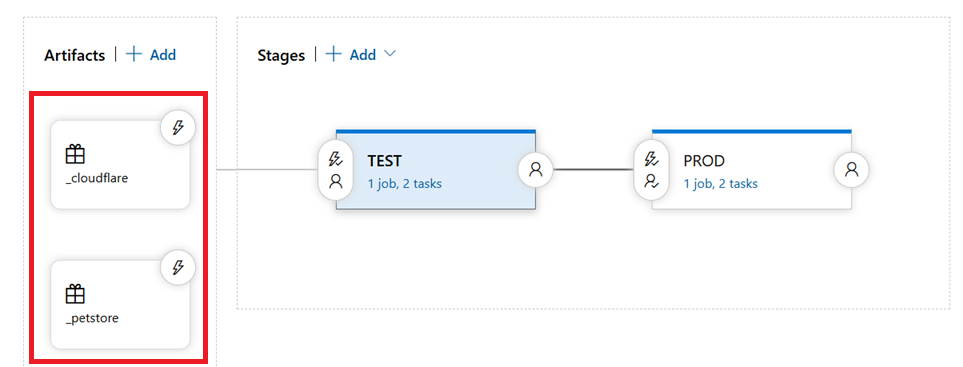
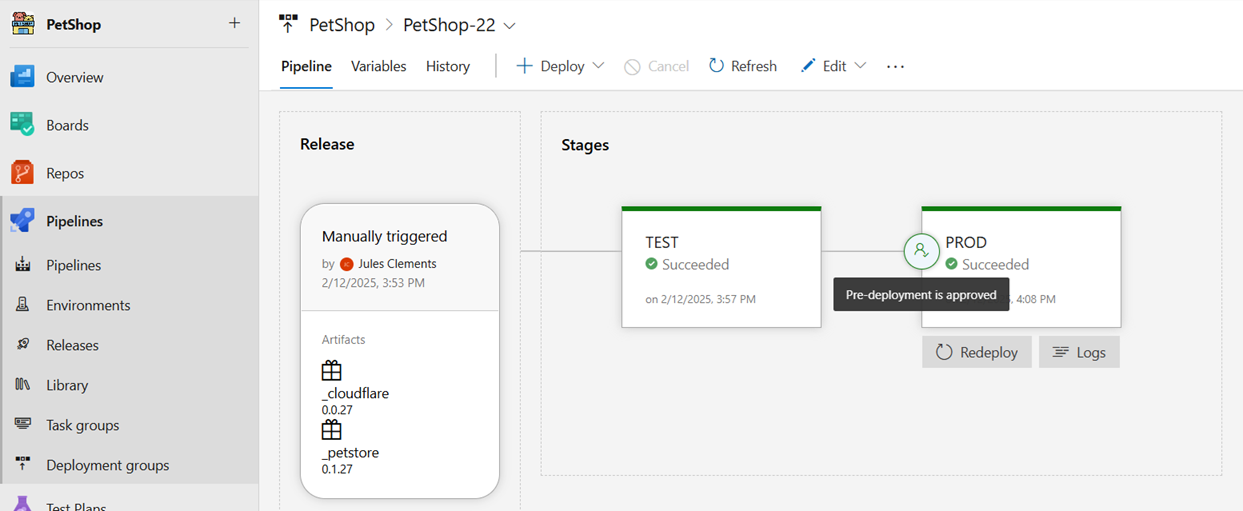
The ADO Release function is used to create a release, and promote it through the environments. The release obtains the components from the artefact store
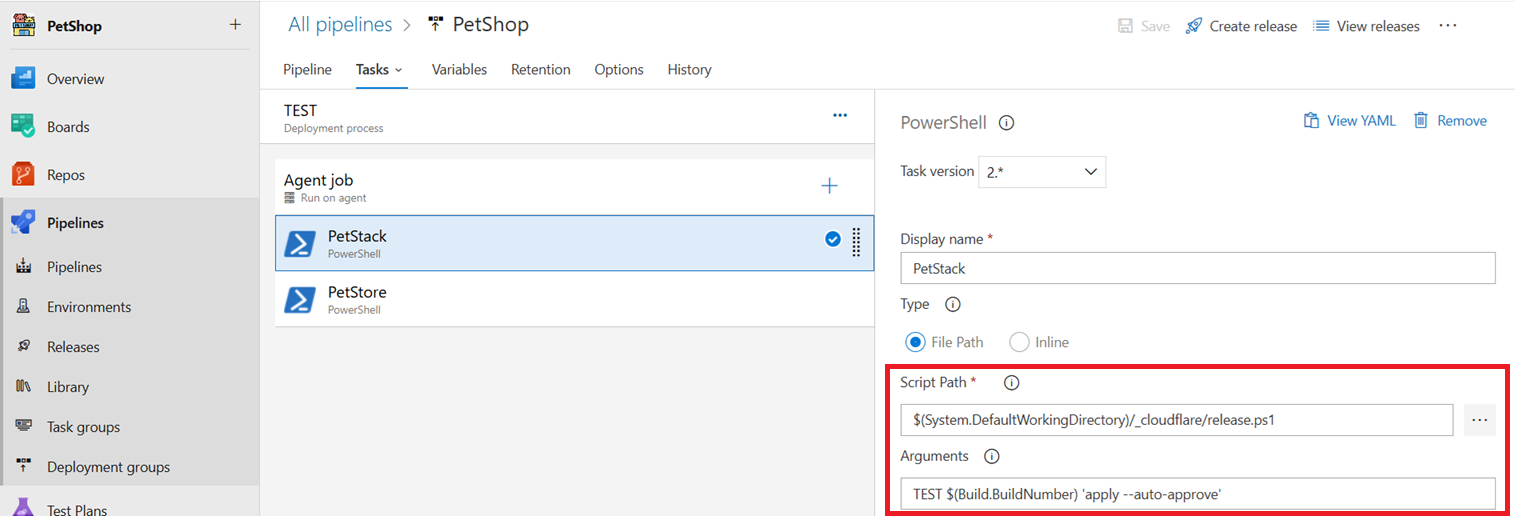
The Release is defined in order of dependency, i.e. the CloudFlare infrastructure is created/updated and configured with the API, then the front-end is deployed to the infrastructure.
The release itself includes to deployment logic, it simply invokes the packages provided by the component development team.
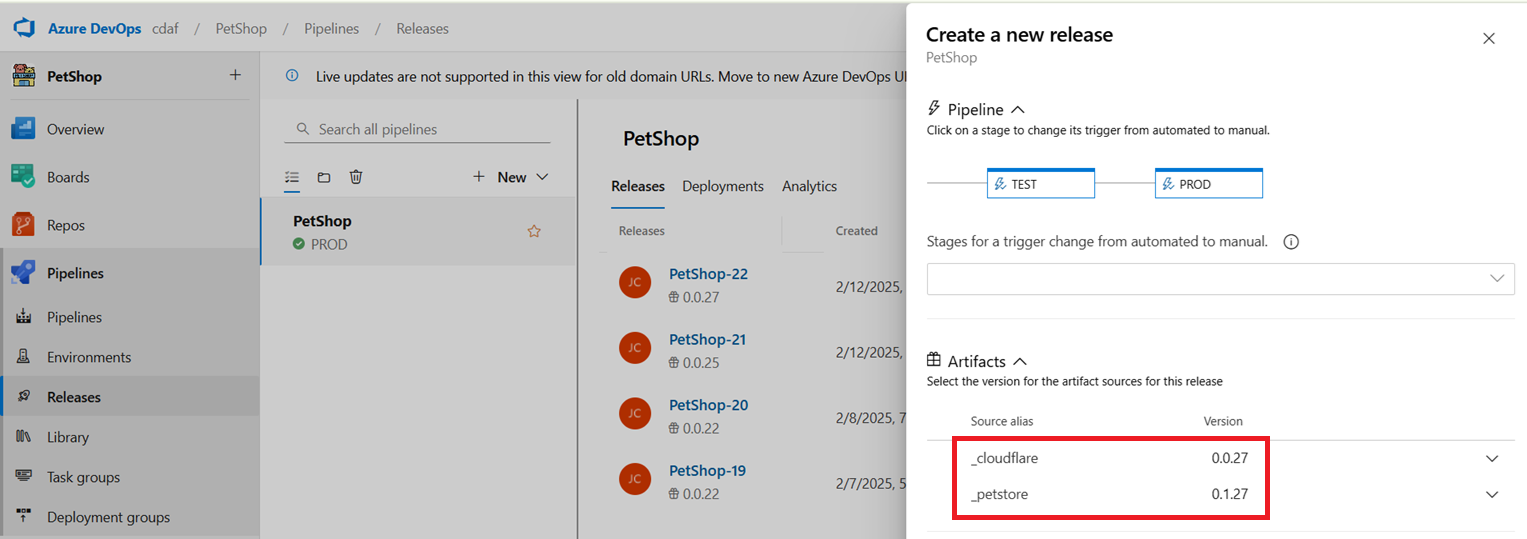
When a new release is created, the latest versions are defaulted, and this defines the manifest for the release, i.e. different versions cannot be deployed to different environments. This ensures the stack is consistency promoted.
The latest versions do not have to selected, but whatever is selected is static for that release instance.
When the release is promoted, no manual intervention is required, except for approval gates, which can be approved by business or product owners, and does not require any further development effort.
Ansible Automation Platform
Full Stack Release using Ansible Automation Platform
Ansible Automation Platform is the replacement for Ansible Tower.
The Application Stack is a combination of Podman containers with an Apache reverse proxy for ingress.
This implementation does not include infrastructure, i.e. the creation of the host and related networking is not included in the automation, however, it does combine configuration management and software delivery.
graph TD
  client["🌐"]:::transparent

  subgraph dc["Data Center"]
    subgraph vm["Host"]
      Apache
      subgraph Podman
        vm1-con-a["Rails"]
        vm1-con-b["Spring"]
        vm1-con-c["Python"]
      end
    end
  end

  client -->
  Apache --> vm1-con-a
  Apache --> vm1-con-b
  Apache --> vm1-con-c

classDef transparent fill:none,stroke:none,color:black

classDef dashed stroke-dasharray: 5, 5
class dc dashed

classDef dotted stroke-dasharray: 2, 2
class Podman dotted
The configuration of the host and deployment of the application are defined once, and deployed many times, e.g. test and production.
graph LR

  subgraph Rails
    Rbuild["Build"] -->
    Rtest["Test"] -->
    Rpublish["Publish"]
  end
  subgraph Python
    Pbuild["Build"] -->
    Ptest["Test"] -->
    Ppublish["Publish"]
  end
  subgraph Spring
    Sbuild["Build"] -->
    Stest["Test"] -->
    Spublish["Publish"]
  end

  subgraph Release
    TEST:::release
    PROD:::release
  end

  store1[(GitLab Docker Registry)]
  store2[(Nexus Docker Registry)]

  Rpublish --> store1
  Spublish --> store1
  Ppublish --> store2
  store1 --> TEST
  store2 --> TEST
  TEST --> PROD

classDef release fill:lightgreen
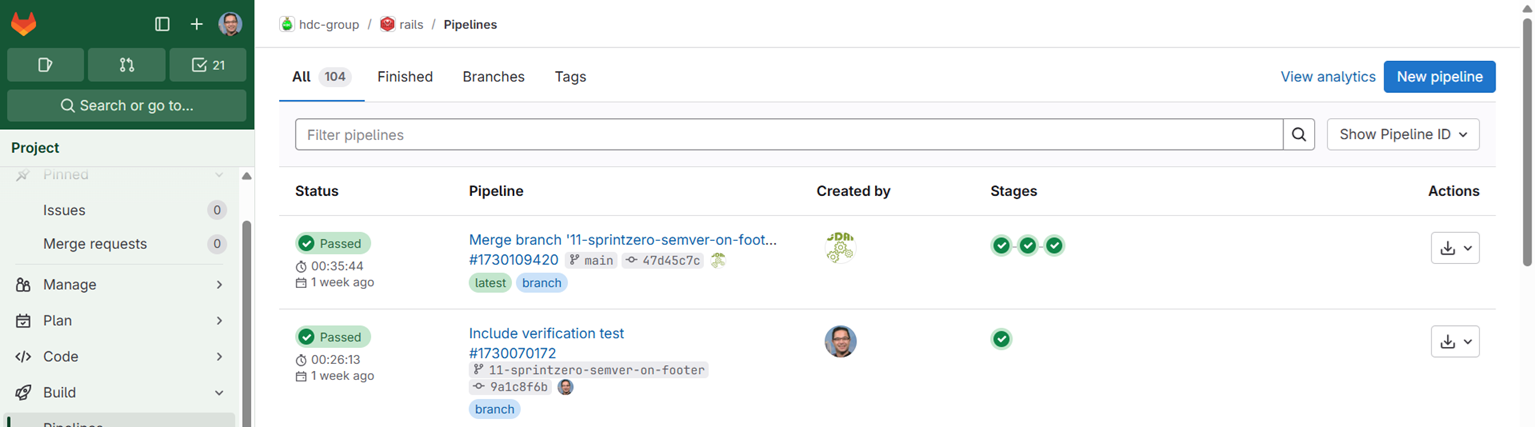
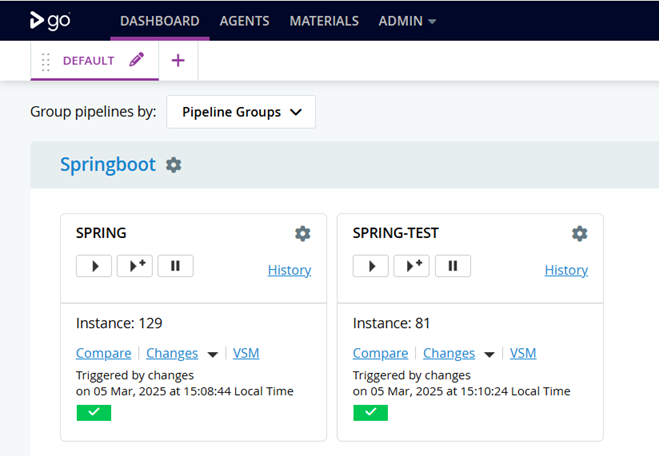
Each development team is responsible to publishing a container image, how they do so it within their control, in this example GitLab and ThoughtWorks Go are used by different teams. The GitLab team are branch based, while the Go team are branch based.
Both teams are using CDAF docker image build and push helpers.
The key component of the package is the release manifest, this declares the component versions of the solution. The desired state engine (Ansible) will ensure all components for the release align with the declaration in the manifest. These are added to your CDAF.solution file. To see an example component build, see the Java SpringBoot example.
While that stack construction is the same in all environments, unique settings for each environment are defined in configuration management files, e.g. properties.cm.
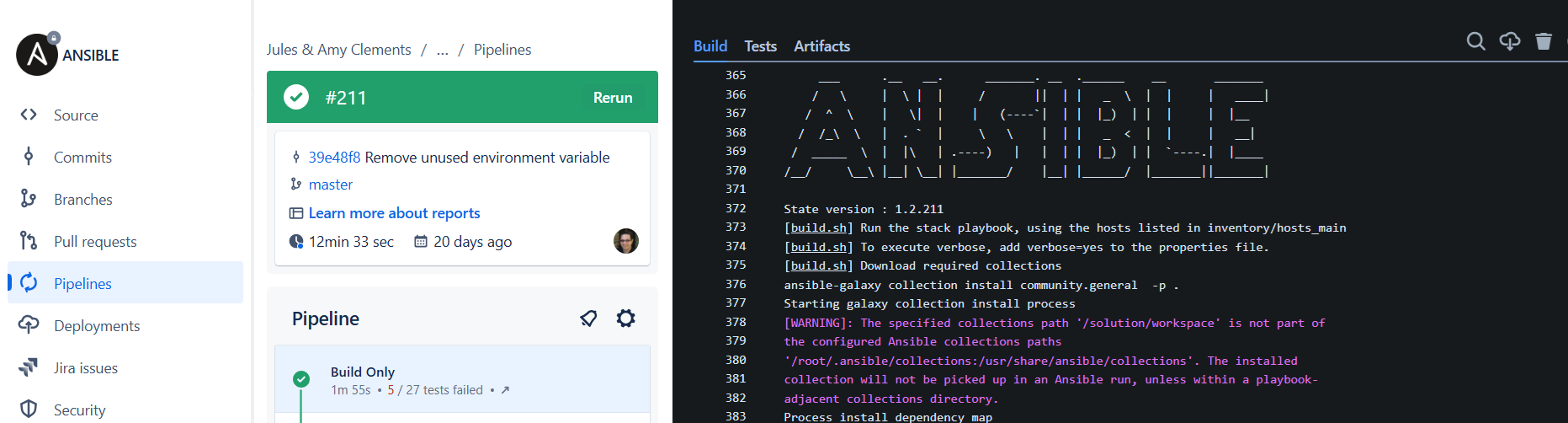
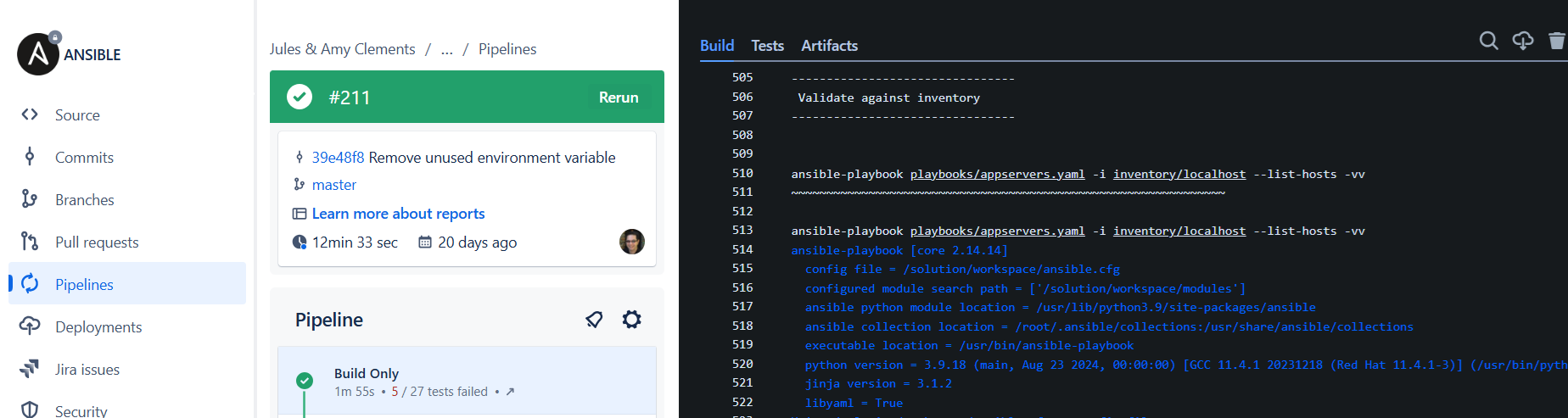
The key construct for the Release Train is that all aspects of the release process are predictable and repeatable. To avoid deploy-time variations in Ansible dependencies, playbooks are not downloaded at deploy time; instead they are resolved at build time and packaged into an immutable release package. For a consistent way-of-working, the Ansible build process resolves dependencies and validates the playbooks.
Due to the complexity, a customer build script build.sh is defined, and broken down into the steps below
Sprint Zero
Based on Sprint-Zero, it is critical that a deployment is verifiable by version. A message of the day (motd) file is generated with the build number included so that a user who logs in to the host can verify what version has been applied.
executeExpression "ansible-playbook --version"echo "[$scriptName] Build the message of the day verification file"; echo
executeExpression "cp -v devops/motd motd.txt"propertiesList=$(eval "$AUTOMATIONROOT/remote/transform.sh devops/CDAF.solution")printf "$propertiesList"eval $propertiesList
cat >> motd.txt <<<"State version : ${artifactPrefix}.${BUILDNUMBER}"cat motd.txt
Resolve Dependencies
Playbooks are then downloaded to the release.
common_collections='community.general ansible.posix containers.podman'for common_collection in $common_collections; do executeExpression "ansible-galaxy collection install $common_collection$force_install -p ."done
Validation
Once all playbooks have been downloaded, syntax is then validated.
for play in `find playbooks/ -maxdepth 1 -type f -name '*.yaml'`; do
	executeExpression "ansible-playbook $play --list-tasks -vv"
	for inventory in `find inventory/ -maxdepth 1 -type f`; do
		echo
		echo "ansible-playbook ${play} -i $inventory --list-hosts -vv"
		echo "~~~~~~~~~~~~~~~~~~~~~~~~~~~~~~~~~~~~~~~~~~~~~~~~~~~~~~~~~~~~~~"
		echo
		executeExpression "ansible-playbook ${play} -i $inventory --list-hosts -vv"
	done
done
Release Package
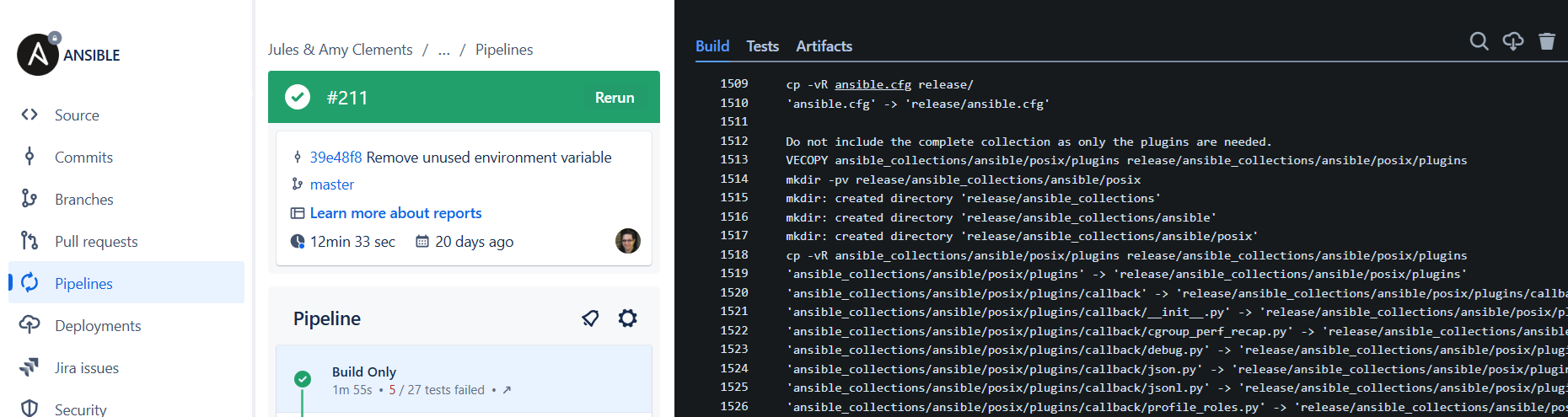
The deploy-time components are then copied into the release package, based on the storeFor definition in your solution directory.
# All Deploy-time Playbooks
release
The playbooks and helper scripts are then packed into a self-extracting release executable as per standard CDAF release build process
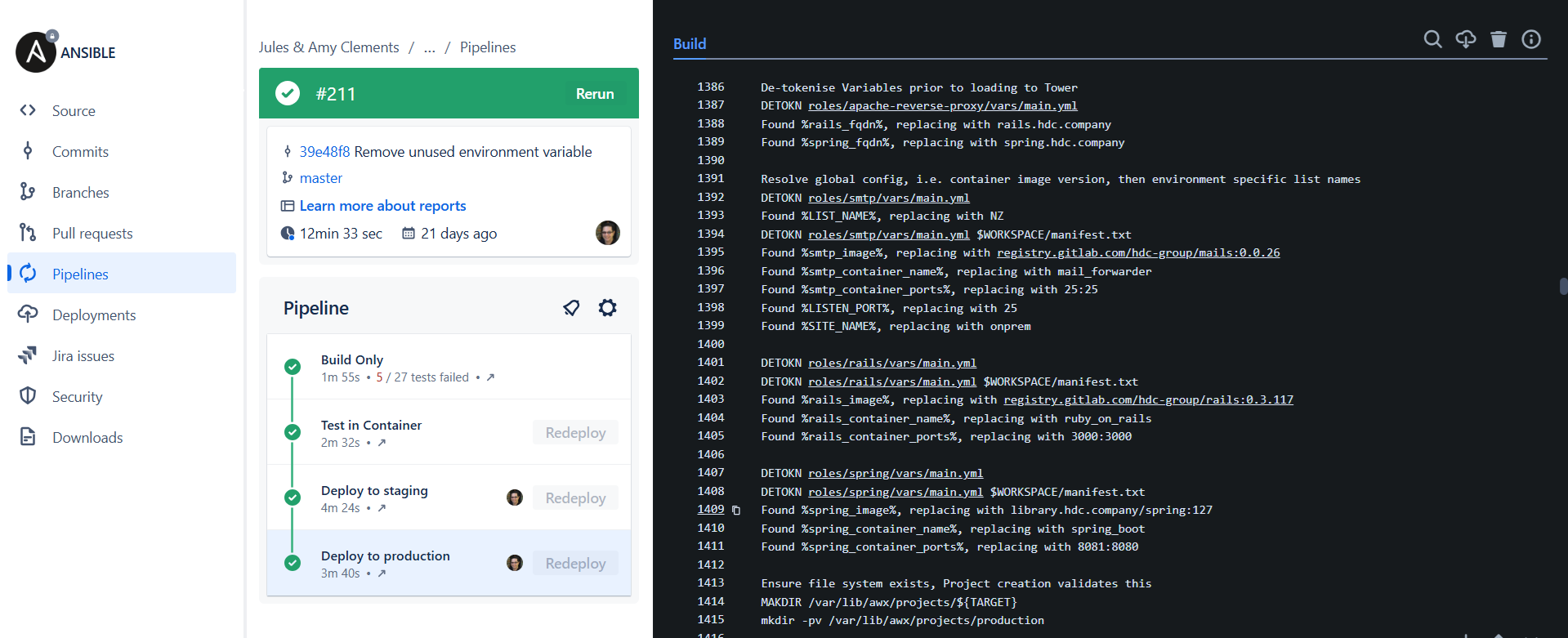
At deploy time, the solution manifest and environment settings are applied, the following is an extract from the tower.tsk.
echo "De-tokenise Environment properties prior to loading to Tower"
DETOKN roles/apache-reverse-proxy/vars/main.yml

echo "Resolve global config, i.e. container image version, then environment specific list names"
DETOKN roles/smtp/vars/main.yml
DETOKN roles/smtp/vars/main.yml $WORKSPACE/manifest.txt

DETOKN roles/rails/vars/main.yml
DETOKN roles/rails/vars/main.yml $WORKSPACE/manifest.txt

DETOKN roles/spring/vars/main.yml
DETOKN roles/spring/vars/main.yml $WORKSPACE/manifest.txt
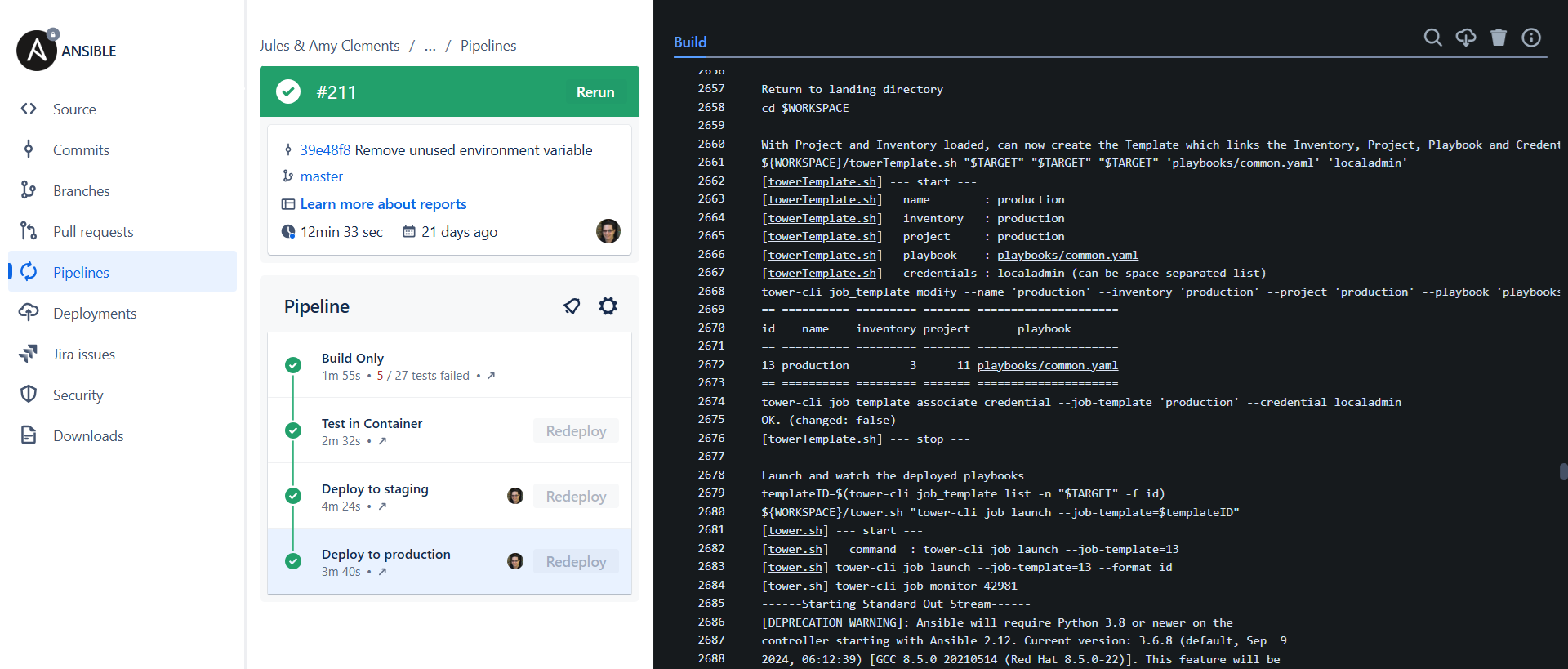
As the Ansible Automation Platform is the intermediary, the declarations need to be moved to intermediary and then the release triggered. In this example, the desired state is continually apply to remediate any drift, but can also be triggered via a command line interface (CLI). The following extract from towerTemplate.sh sets up the configuration
templateID=$(tower-cli job_template list -n "${name}" -f id)
if [ -z $templateID ]; then
	executeExpression "tower-cli job_template create --name '${name}' --inventory '${inventory}' --project '${project}' --playbook '${playbook}' --verbosity more_verbose"
else
	executeExpression "tower-cli job_template modify --name '${name}' --inventory '${inventory}' --project '${project}' --playbook '${playbook}' --verbosity more_verbose"
fi

for credential in $credentials; do
	executeExpression "tower-cli job_template associate_credential --job-template '${name}' --credential ${credential}"
done
once configured, the deployment is triggered.
echo "With Project and Inventory loaded, can now create the Template which links the Inventory, Project, Playbook and Credentials"
${WORKSPACE}/towerTemplate.sh "$TARGET" "$TARGET" "$TARGET" 'playbooks/common.yaml' 'localadmin'

echo "Launch and watch the deployed playbooks"
templateID=$(tower-cli job_template list -n "$TARGET" -f id)
tower-cli job launch --job-template=$templateID
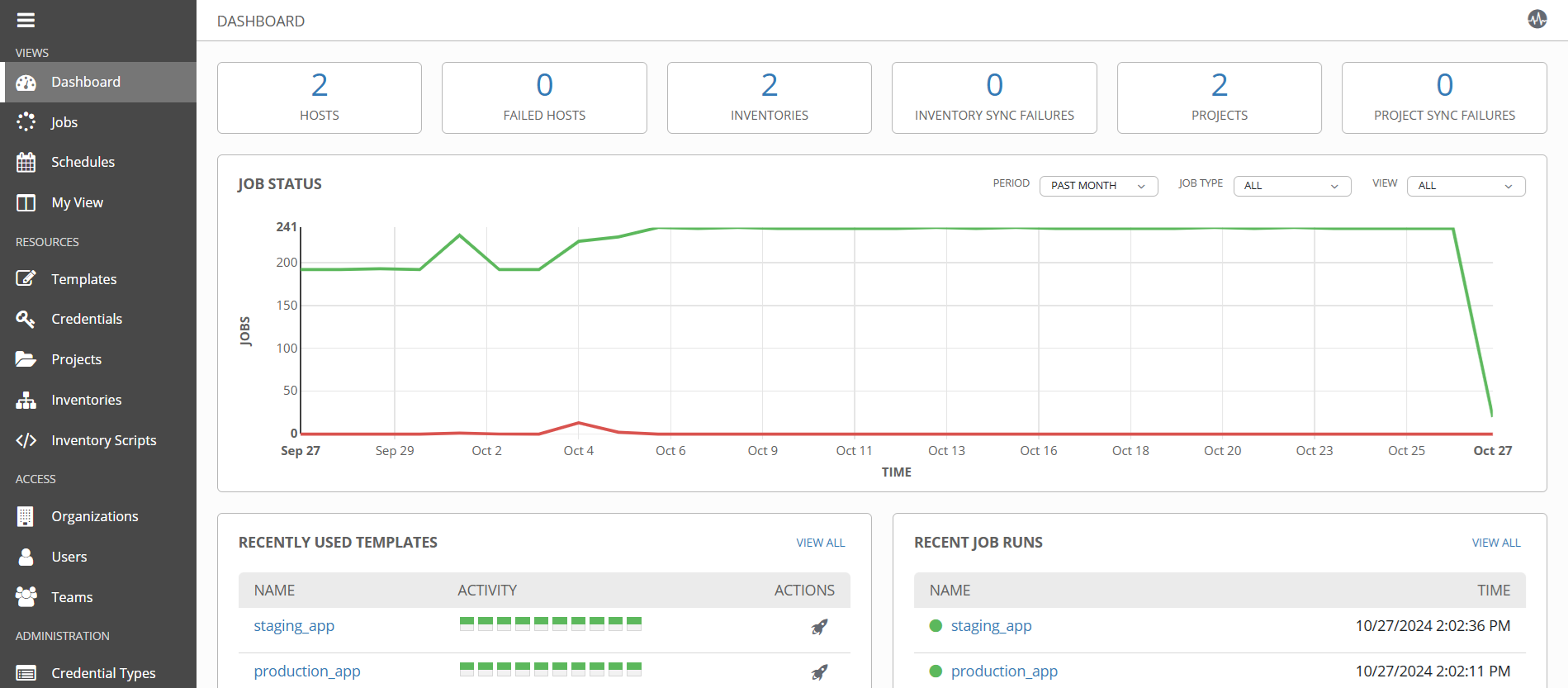
An overview of deployment activity and state management is available in the intermediary user interface.
Octopus Deploy
Release Orchestration using Octopus Deploy
Octopus Deploy is a dedicated release orchestration tool which did not have build capabilities and historically did not natively integrate with source control, instead it focusses a registry to which artefacts can be pushed.
By decoupling from source control, Octopus provides an idea release train platform as it’s core focus is on releasing deployments. This also allows the independent orchestration of disparate tools, providing visibility of release outcomes to business a audience.
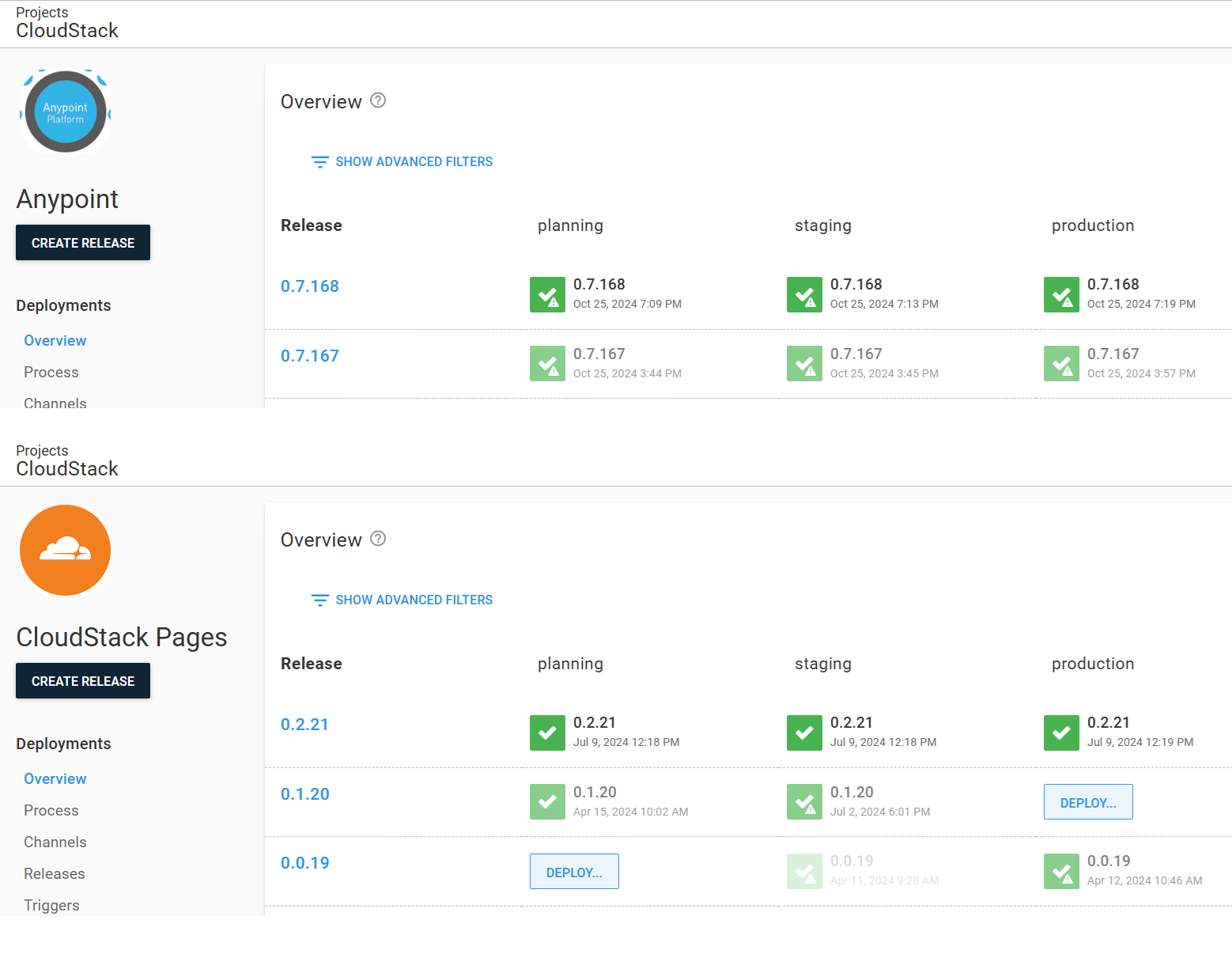
By using a solution project, all the component projects can be orchestrated as a single manifest, i.e. a release train.
The following scenario is a stack which comprises a customer-facing application (React) front-end and Platform-as-a-Service (Mulesoft Anypoint) back-end.
The back-end deployment is itself an authoritative release solution with a source-driven manifest (see Custom Desired State Management Solution). The client will retrieve the static content from the content delivery network (CloudFlare).
graph TD
  client["🌐"]:::transparent

  subgraph cf["CloudFlare"]
    react-a["Static Content"]
  end

  subgraph ch["CloudHub"]
    patient["Patient API"]
    Admissions["Admissions API"]
  end

  client --> react-a
  client --> patient
  patient --> Admissions

classDef external fill:lightblue
class client external

classDef dashed stroke-dasharray: 5, 5
class cf,ch dashed
Octopus creates a release whenever either the state management or user interface packages are pushed, but this is not deployed into test until the release manager approves. The API construction and registration with AnyPoint exchange is not described here, this is treated as a prerequisite, see Custom Desired State Management Solution for a detailed breakdown of that process.
graph LR

  subgraph "Patient API"
    Rbuild["Build"] -->
    Rtest["Test"] -->
    Rpublish["Publish"]
  end
  subgraph "AnyPoint Desired State Management"
    Pbuild["Build"] -->
    Ptest["Test"] -->
    Ppublish["Publish"]
  end
  subgraph "Admissions API"
    Sbuild["Build"] -->
    Stest["Test"] -->
    Spublish["Publish"]
  end
  subgraph "CloudFlare Pages"
    Abuild["Build"] -->
    Atest["Test"] -->
    Apublish["Publish"]
  end

  subgraph Release
    TEST:::release
    PROD:::release
  end

  store1[(Anypoint Exchange)]
  store2[(Octopus Package Registry)]

  Rpublish --> store1
  Spublish --> store1
  Ppublish --> store2
  Apublish --> store2

  store1 --> TEST
  store2 --> TEST
  TEST --> PROD

classDef release fill:lightgreen
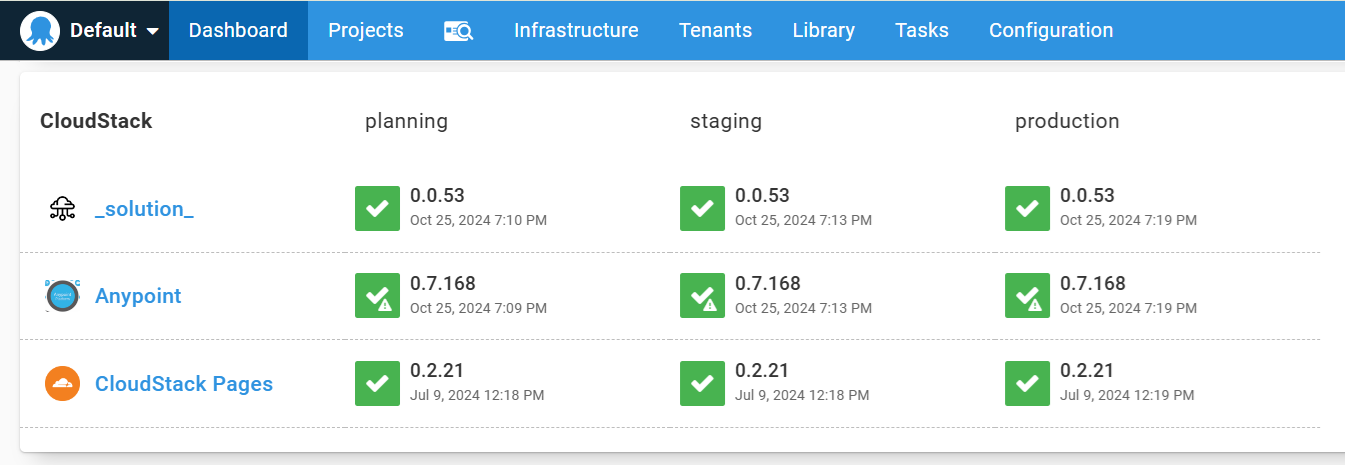
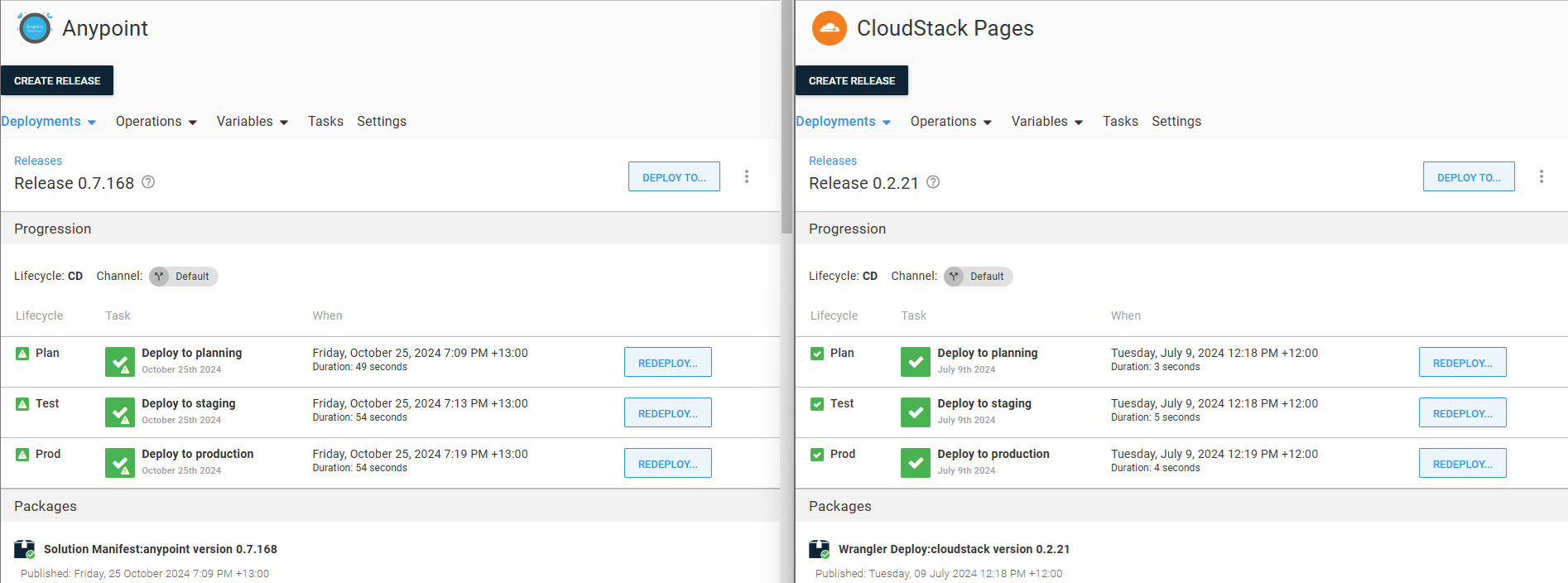
As an intermediary, Octopus provides release gating, orchestration and an overview of the stack components, and what versions have been promoted to which environments.
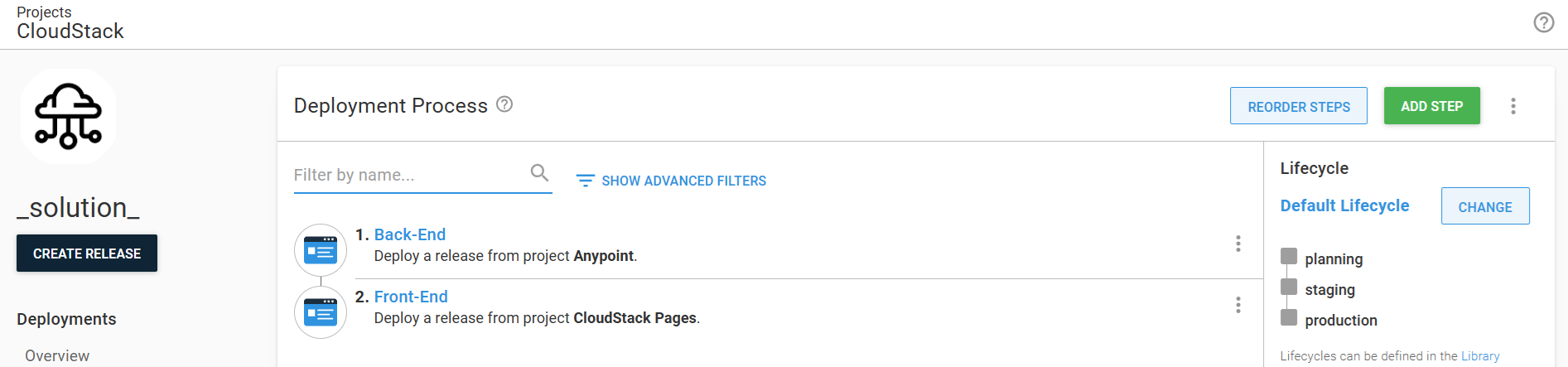
Parent Project
The parent project does not perform any deployment activity itself, it serves as the orchestrator of the child projects, providing gating and sequencing.
Child Projects
The child project, use the same template process, but each has the release packages that have been build to perform their technology specific deployment process.
Component Independence
The approach above does offer the ability to independently promote or roll-back a child component. This can be beneficial for hot-fixes, however, it is discouraged as it breaks the stack alignment principles of the release train.
The core principle of all the examples in this material is the production of a self-contained, immutable release package. This provides loose coupling with tool chains and re-usability for development environments (see Realising the Feedback Loop).
While Octopus provides a wide range of deployment mechanisms, as a release orchestrator, each child project has the same process, executing the release package for each component against the target environment.
Delivery Lifecycle
Octopus orchestration is called a lifecycle, which is a re-usable pattern. Each child item can use the same lifecycle because the deployment launch process is the same.
While the launch process is the same, each child components underlying technologies can be very different.
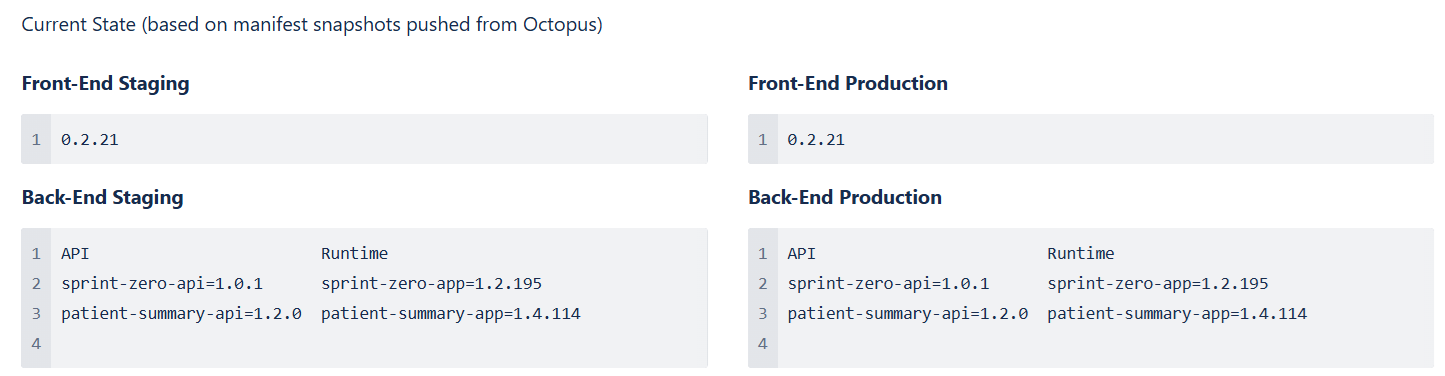
After each environment deployment is successful, a Confluence page (one per component/environment) is updated, capturing release details. This provides visibility outside of the toolchain, which is easier to access by business users such as test managers and product owners. Using the content include macro, these pages can be merged.
when using containers, the package pushed to Octopus does not contain the software solution itself, but instead, simply helper scripts to managed the download and instantiation of containers from the container registry.
graph LR

  subgraph "Component 1"
    Rbuild["Build"] -->
    Rtest["Test"] -->
    Rpush["Push"] -->
    Rpublish["Publish"]
  end
  subgraph "Component 2"
    Pbuild["Build"] -->
    Ptest["Test"] -->
    Ppush["Push"] -->
    Ppublish["Publish"]
  end

  subgraph Release
    subgraph TEST
      rcontainer
      pcontainer
    end
    PROD
  end

  store1[(Container Registry)]
  store2[(Octopus Package Registry)]

  Rpush --> store1
  Ppush --> store1
  Rpublish --> store2
  Ppublish --> store2

  store2 --> TEST
  store1 --> rcontainer
  store1 --> pcontainer
  TEST --> PROD

classDef release fill:lightgreen
class TEST,PROD release
Terraform Cloud
Full Stack Release using Terraform Cloud
This Release Train extends the Terraform Kubernetesauthoritative release, combining the application stack deployment with the Infrastructure-as-Code solution.
graph TD
  client["🌐"]:::transparent

  apim["API Gateway"]

  subgraph k8s["Kubernetes"]
    subgraph ns1["Dev namespace"]
      ns1-ingress["ingress"]
      subgraph ns1-pod-1["Pod"]
        ns1-con-a["container"]
      end
      subgraph ns1-pod-2["Pod"]
        ns1-con-b["container"]
        ns1-con-c["container"]
      end
    end
  end

  client -->
  apim -->
  ns1-ingress --> ns1-con-a
  ns1-ingress -->
  ns1-con-b --> ns1-con-c

classDef external fill:lightblue
class client external

classDef dashed stroke-dasharray: 5, 5
class ns1,ns2,ns3 dashed

classDef dotted stroke-dasharray: 2, 2
class ns1-pod-1,ns1-pod-2,ns2-pod-1,ns2-pod-2,ns3-pod-1,ns3-pod-2 dotted
Each component publishes a self-contained release package to the Azure DevOps (ADO) artefact store. The ADO Release orchestrates these package deployments for each environment, ensuring the complete stack is promoted through each environment with aligned package versions.
graph LR

  subgraph Components
    Sbuild["Build"] -->
    Stest["Test"] -->
    Spublish["Publish"]
  end
  subgraph Infrastructure
    Abuild["Build"] -->
    Atest["Test"] -->
    Apublish["Publish"]
  end

  subgraph Release
    TEST
    PROD
  end

  store[(ADO Store)]

  Apublish --> store
  Spublish --> store
  store --> TEST
  TEST --> PROD

classDef release fill:lightgreen
class TEST,PROD release
The key component of the package is the release manifest, this declares the component versions of the solution. The desired state engine (Terraform) will ensure all components for the release align with the declaration in the manifest. These are added to your CDAF.solution file.
While the stack construction is the same in all environments, unique settings for each environment are defined in configuration management files, e.g. properties.cm. The properties management is covered in more detail in the Configuration Management section.
The key construct for the Authoritative Release is that all aspects of the release process are predictable and repeatable. To avoid deploy-time variations in Terraform dependencies, modules are not downloaded at deploy time; instead they are resolved at build time and packaged into an immutable release package. For a consistent way-of-working, the Terraform build process resolves and validates dependencies.
Build-time Module Resolution
Most Terraform module resolution approaches are to pull from source control (Git) or registry at deploy-time, which can require additional credential management, risk unexpected module changes (if tags are used), and introduce potential network connectivity issues. This approach treats modules like software dependencies: resolve them at build time and include them in an all-in-one immutable package.
The following state.tf defines the modules and versions that are required
The following build.tsk triggers module download from a private registry using credentials in TERRAFORM_REGISTRY_TOKEN; these credentials will not be required at deploy time.
Write-Host "[$TASK_NAME] Verify Version`n" -ForegroundColor Cyan
terraform --version
VARCHK
MAKDIR $env:APPDATA\terraform.d
$conf = "$env:APPDATA\terraform.d\credentials.tfrc.json"Set-Content $conf '{'Add-Content $conf ' "credentials": {'Add-Content $conf ' "app.terraform.io": {'Add-Content $conf " `"token`": `"$env:TERRAFORM_REGISTRY_TOKEN`""Add-Content $conf ' }'Add-Content $conf ' }'Add-Content $conf '}'Get-Content $conf
Write-Host "[$TASK_NAME] Log the module registry details`n" -ForegroundColor Cyan
Get-Content state.tf
Write-Host "[$TASK_NAME] In a clean workspace, first init will download modules, then fail, ignore this and init again"if ( ! ( Test-Path ./.terraform/modules/azurerm )) { IGNORE "terraform init -upgrade -input=false" }
Write-Host "[$TASK_NAME] Initialise with local state storage and download modules`n" -ForegroundColor Cyan
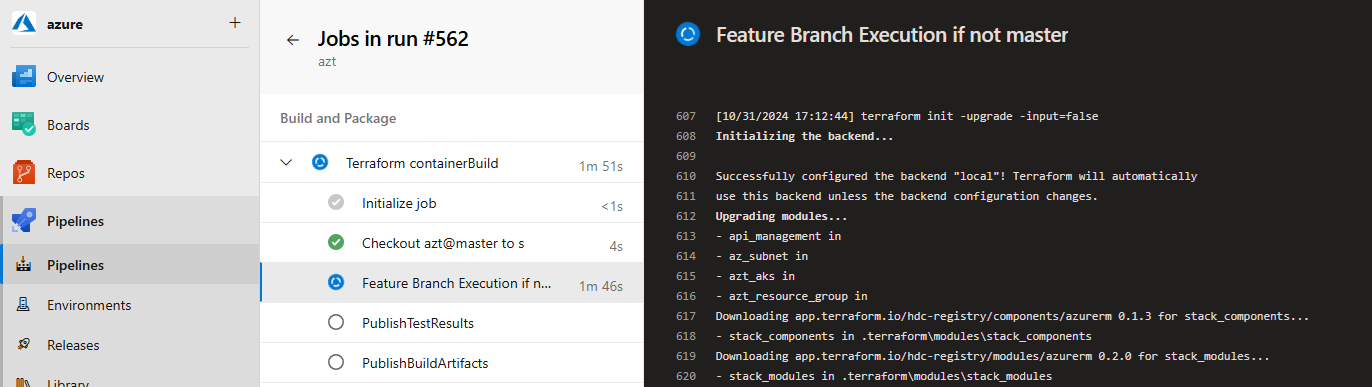
terraform init -upgrade -input=false
Validation
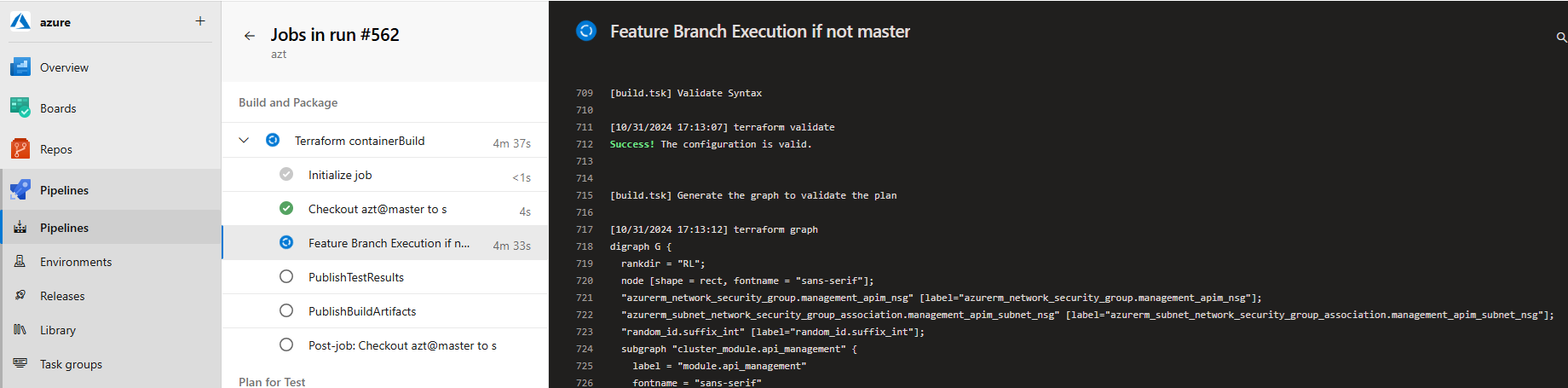
Once all modules have been downloaded, syntax is then validated.
Write-Host "[$TASK_NAME] Validate Syntax`n" -ForegroundColor Cyan
terraform validate

Write-Host "[$TASK_NAME] Generate the graph to validate the plan`n" -ForegroundColor Cyan
terraform graph
Numeric Token Handling
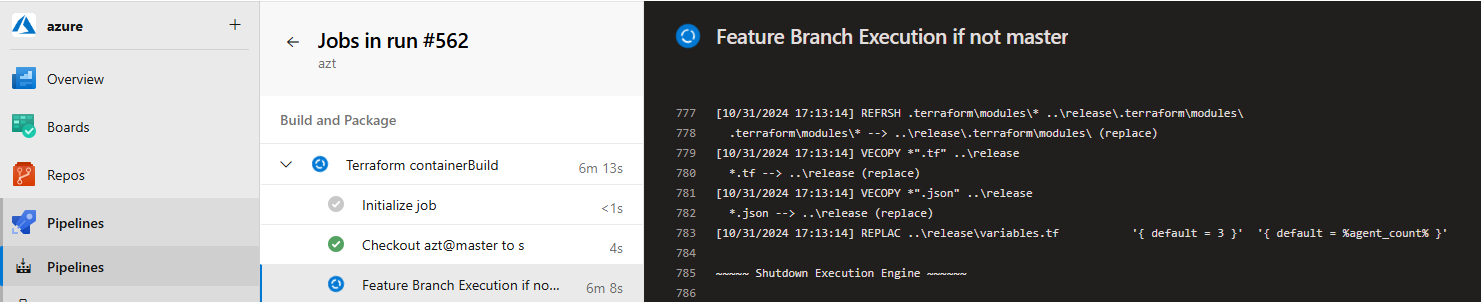
All the deploy-time files are copied into the release directory. Because tokens cannot be used during the build process, an arbitrary numeric is used, and this is then replaced in the resulting release directory. Tokenisation is covered in more detail in the following section
To De-tokenise this definition at deploy time, name/value pair files are used. This allows the settings to be decoupled from the complexity of configuration file format.
If these were to be stored as separate files in source control, they would suffer the same drift challenge, so in source control, the settings are stored in a tabular format, which is compiled into the name/value files during the Continuous Integration process.
target  aks_work_space  name_space  REGISTRY_KEY       REGISTRY_KEY_SHA
TEST    aks_prep        test        $env:REGISTRY_KEY  FD6346C8432462ED2DBA6...
PROD    aks_prod        prod        $env:REGISTRY_KEY  CA3CBB1998E86F3237CA1...
Note: environment variables can be used for dynamic value replacement, most commonly used for secrets.
These human readable configuration management tables are transformed to computer friendly format and included in the release package (release.ps1). The REGISTRY_KEY and REGISTRY_KEY_SHA are used for Variable Validation, creating a properties.varchk as following
env:REGISTRY_KEY=$env:REGISTRY_KEY_SHA
Write the REGISTRY_KEY_SHA aa a container environment variable, so that when SHA changes, the container is automatically restarted to pick up the environment variable change, and hence the corresponding secret is also reloaded.
env {
  name = "REGISTRY_KEY_SHA"
  value = var.REGISTRY_KEY_SHA
}
An additional benefit of this approach is that when diagnosing an issue, the SHA can be used as an indicative secret verification. How these are consumed are described later in the deploy section.
The release combines the Infrastructure-as-Code (IaC) Continuous Integration (CI) output with the application components from Terraform Authoritative Release. The application authoritative release package (in green below) declares the image versions to be deployed to the infrastructure provided by the IaC release package.
graph LR
  Key["Legend<br/>Blue - IaC & CM<br/>Green - Application Stack"]

  subgraph ado["Azure DevOps"]
    git[(Git)]
    build-artefact[(Build)]
    iac["release.ps1"]
    package-artefact[(Artifacts)]
    app["release.ps1"]
  end

  subgraph az["Azure"]
    qa
    pp
    pr
  end

  registry[(Docker Registry)]

  git --CI--> build-artefact
  build-artefact --CD--> iac

  package-artefact --CD--> app

  registry -. "pull image" .-> qa
  app -. "terraform apply" .-> qa
  iac -. "terraform apply" .-> qa

  classDef infra fill:LightBlue
  class iac,az infra

  classDef app-stack fill:LightGreen
  class registry,app app-stack
In this example, the application release pipeline only deploys to the development environment to verify the package, and then pushes to the artefact store
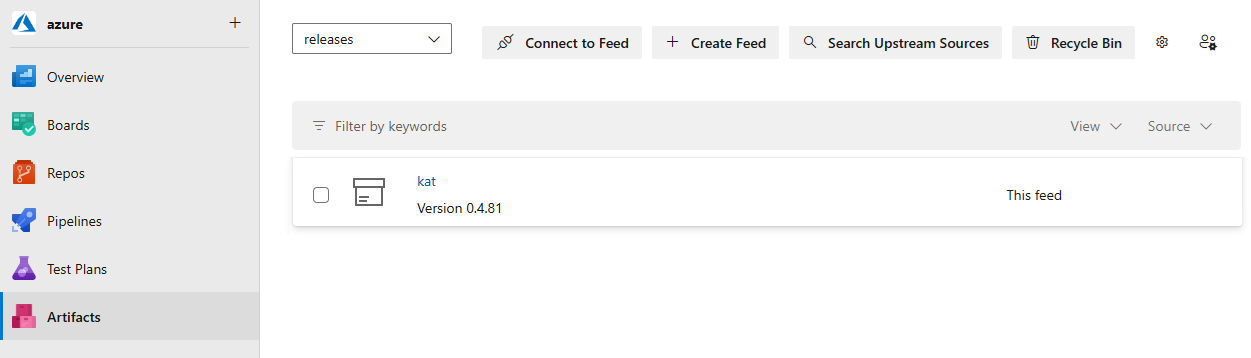
The package, based on its semantic version, is pulled from this store at deploy time, based on the solution manifest, CDAF.solution.
artifactPrefix=0.5
productName=Azure Terraform for Kubernetes
solutionName=azt

kat_release=0.4.80
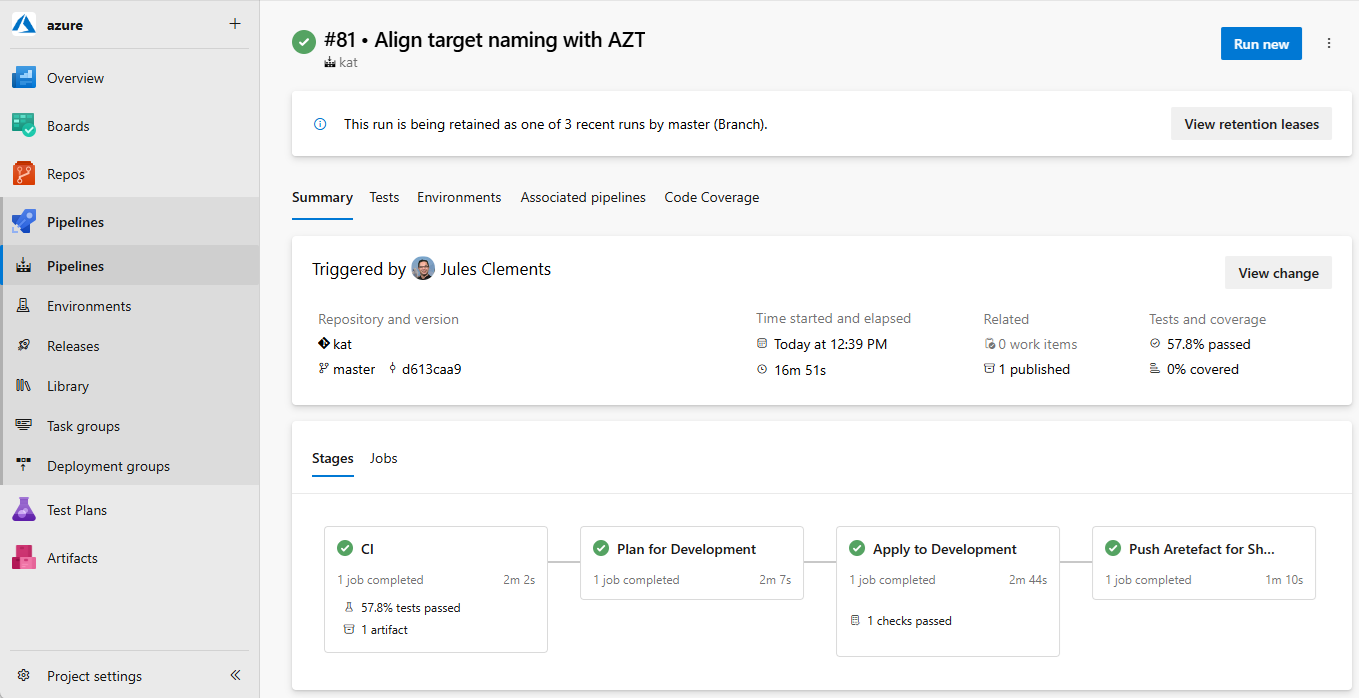
the two release artefacts are promoted together through the pipeline
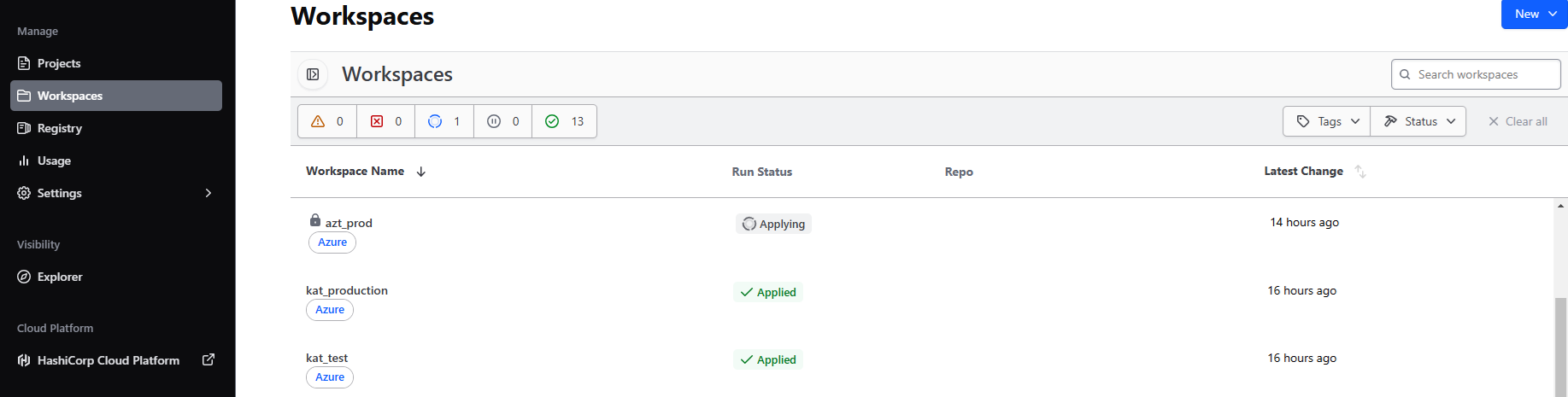
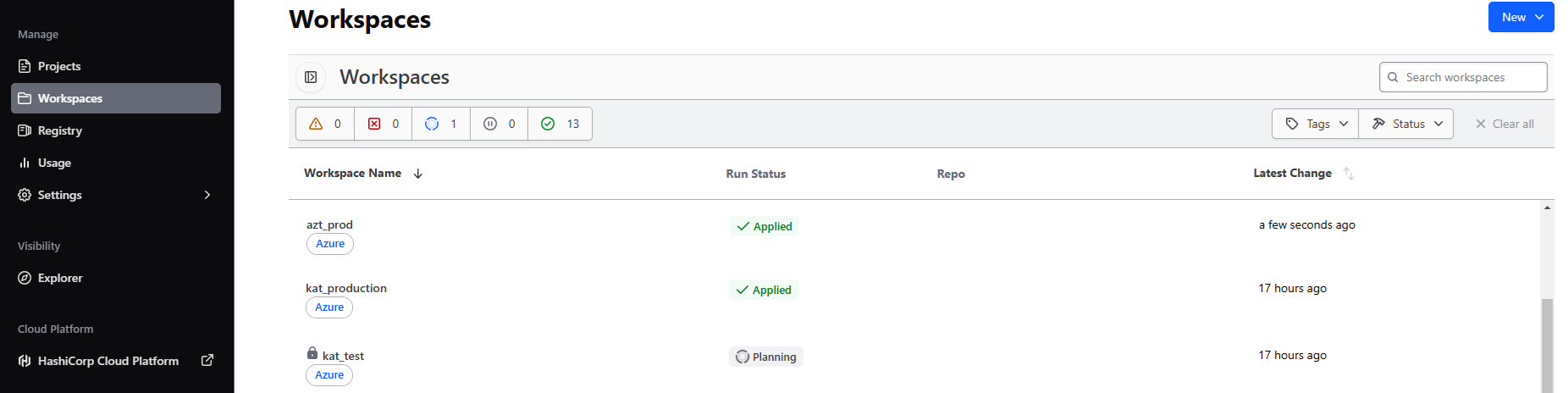
The deployment process itself is processed via the Terraform Cloud intermediary, which decouples the configuration management, and provides state storage and execution processing.
.
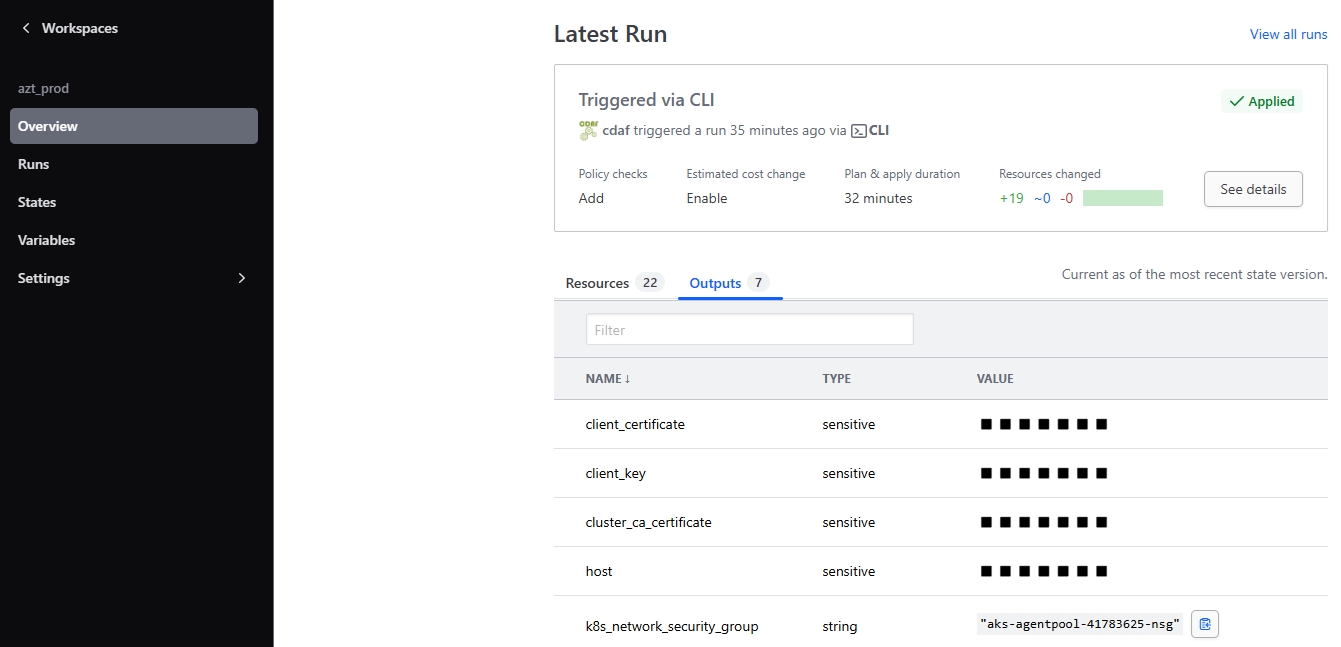
An important aspect of the intermediaries function is to store dynamic outputs, for example, the Infrastructure-as-Code solution provides a Kubernetes cluster, the dynamically created configuration is stored as outputs.
.
The outputs are made available to the subsequent application deployment process.
.
The Application components consume the state information that has been shared
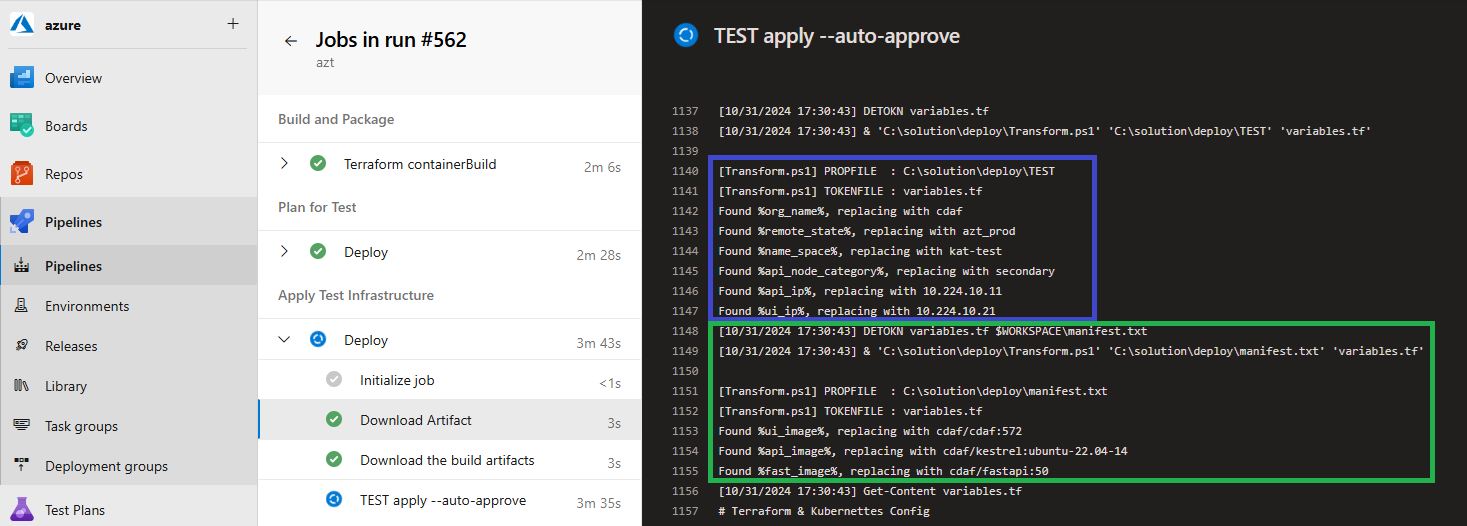
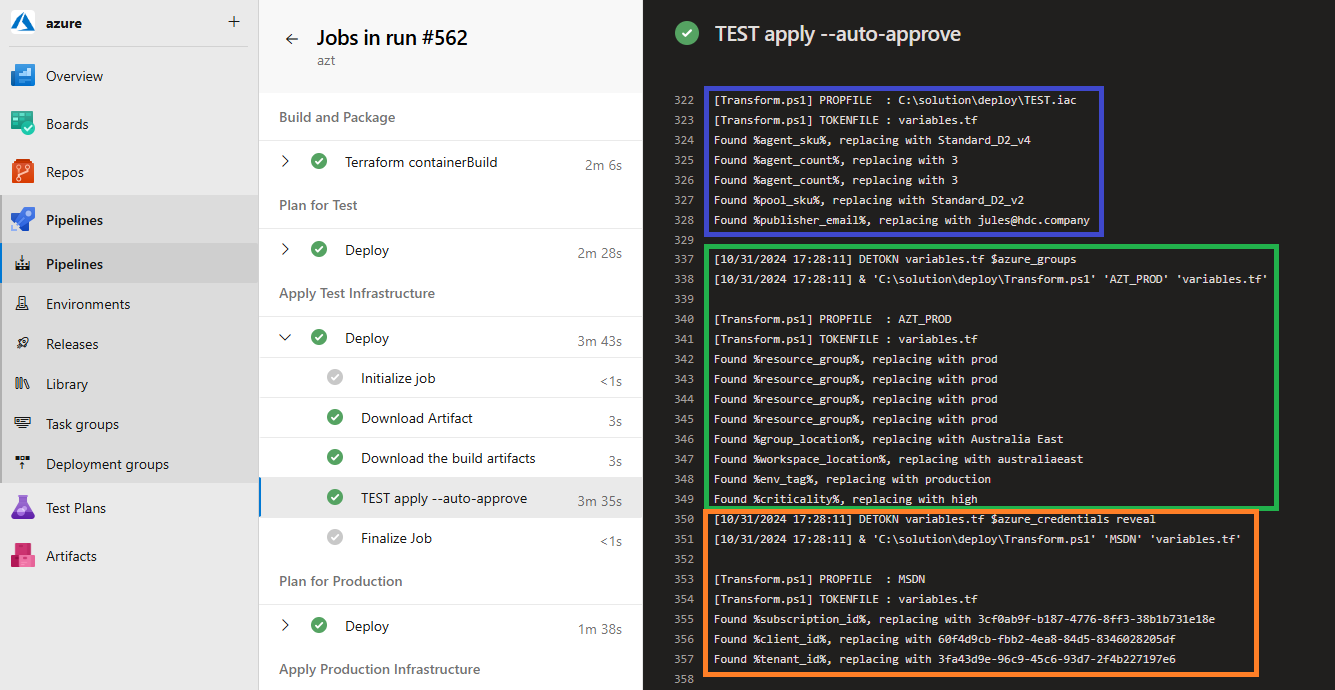
To support the build-once/deploy-many model, the environment specific values are injected and then deployed for the release. Note that the release is immutable, and any change to any component will require a new release to be created, eliminating cherry picking. The tasksRun.tsk performs multiple levels of detokenisation, the first is for environment specific settings, the second applies any solution level declarations, then cluster, groups/regions and non-secret elements of the credentials
Environment (TARGET) specific de-tokenisation is blue, and solution level de-tokenisation in green:
Cluster de-tokenisation is blue, group/region de-tokenisation in green and on-secret elements of the credentials in orange:
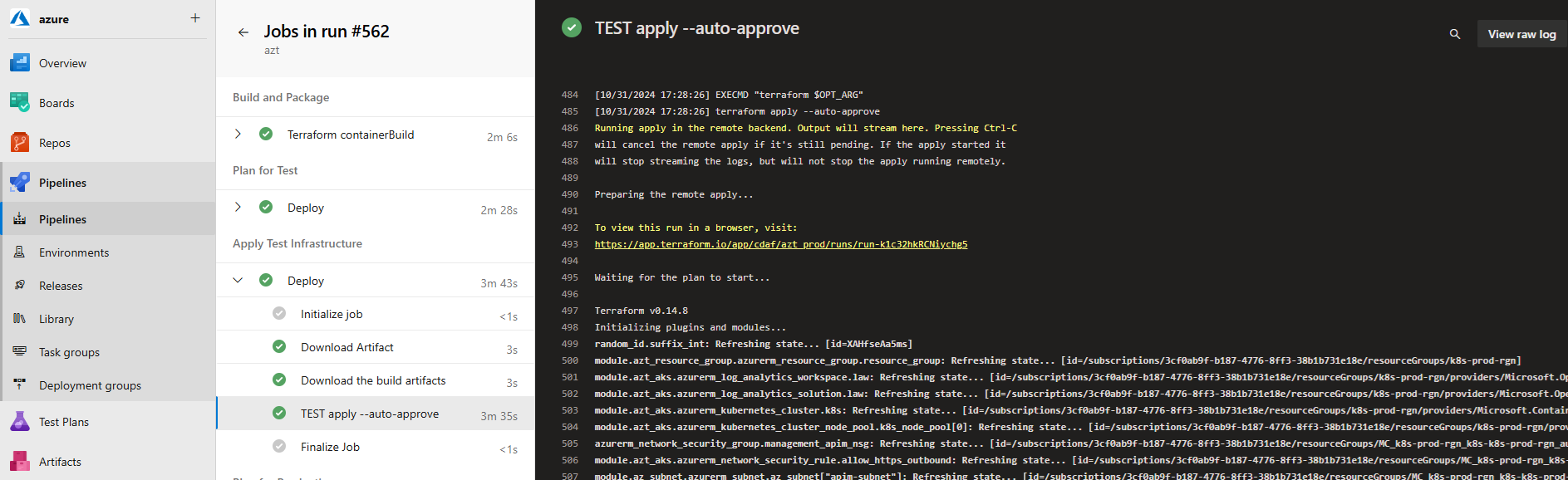
Terraform Cloud is being used to perform state management. To avoid false negative reporting on Terraform apply, the operation is performed in a CMD shell.
Write-Host "[$TASK_NAME] Azure Secrets are stored in the back-end, the token opens access to these"
MAKDIR "$env:APPDATA\terraform.d"
$conf = "$env:APPDATA\terraform.d\credentials.tfrc.json"
Set-Content $conf 'credentials "app.terraform.io" {'
Add-Content $conf "  token = `"$env:TERRAFORM_TOKEN`""
Add-Content $conf '}'

Write-Host "[$TASK_NAME] Replace Local State with Remote, load env_tag from $azure_groups"
PROPLD $azure_groups
$remote_state = "state.tf"
Set-Content $remote_state 'terraform {'
Add-Content $remote_state '  backend "remote" {'
Add-Content $remote_state "    organization = `"${env:TERRAFORM_ORG}`""
Add-Content $remote_state '    workspaces {'
Add-Content $remote_state "      name = `"${SOLUTION}_${resource_group}`""
Add-Content $remote_state '    }'
Add-Content $remote_state '  }'
Add-Content $remote_state '}'

terraform init -upgrade -input=false

Write-Host "[$TASK_NAME] Default action is plan`n" -ForegroundColor Cyan
if ( ! $OPT_ARG ) { $OPT_ARG = 'plan' }
EXECMD "terraform $OPT_ARG"
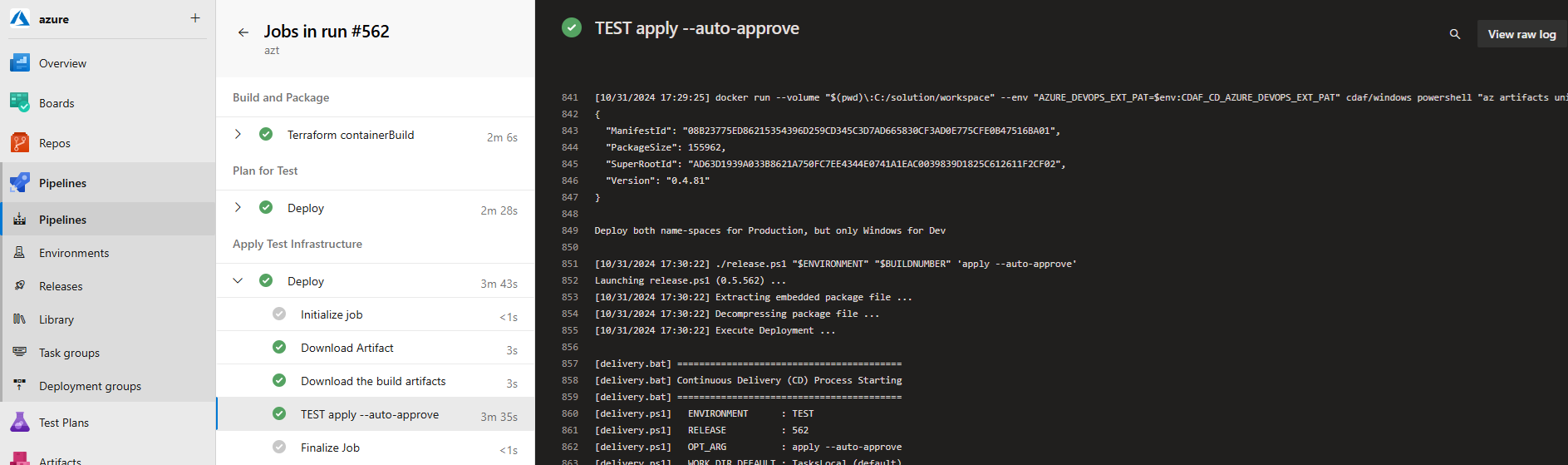
Once the infrastructure has been deployed, the application components are installed. The release package is downloaded (in this example an container with the AZ extensions pre-installed is used) and then run for the environment.
The package can be retrieved using the semantic version, or latest (current production).
Operations
Operational tasks can be performed using the production (latest) or specific release. In this example, a production-like development environment can be created and destroyed on demand.